Shoulder pain treatment · Melbourne

Shoulder pain that keeps you up at night

Cannot sleep on that side, cannot reach the top shelf, been told there is a tear on your scan? Most shoulder pain is managed without surgery. We work out what is driving it and build back what your shoulder can do.

No referral neededFour Melbourne clinicsHealth fund claiming
Dr Ashton Wilson from Alpha Sports MedicineMeet the Alpha teamCare matched to your goals
WHAT

What we see most

Does this sound like your shoulder?

These are the patterns we see most often. They are a starting point for a conversation—not a diagnosis.

01

Rotator cuff-related pain

Reaching, lifting overhead or lying on it

The most common presentation we see. Pain on the outside of the upper arm when reaching or lifting, a sense of weakness and pain at night. The rotator cuff tendons often behave like a tendinopathy, which changes how we approach them.

Understanding tendinopathy
02

“Impingement”

Told something is pinching

A term still common on reports, but it has fallen out of favour clinically. It suggests a tendon being mechanically pinched, which is usually not the full story. In practice it most often describes rotator cuff-related pain that is sensitive to certain positions and loads.

03

Frozen shoulder

Stiff in every direction

Progressive stiffness with a genuine loss of movement in every direction—not just a painful shoulder that still moves. If this sounds like you, our frozen shoulder article explains more.

Read about frozen shoulder
04

Instability and dislocation

Slipping, clunking or coming out

More common in younger, active people and contact or overhead sports. A shoulder that has dislocated, or feels like it slips, needs a careful assessment and a structured return to sport.

05

AC joint pain

A sore point on top of the shoulder

Pain at the bony point on top of the shoulder, often after a fall onto it or a tackle. Reaching across the body commonly aggravates it.

06

Pain referred from the neck

Shoulder pain that is not the shoulder

A real and frequently missed cause. Pain that spreads from the neck, changes with neck movement or comes with pins and needles down the arm may start higher up.

Neck pain
SCAN

About that scan

A tear on a scan is not a sentence

If an ultrasound or MRI report says you have a rotator cuff tear, it is understandable to feel alarmed. But rotator cuff tears are very common in people who have no shoulder pain at all, and they become more common with age. Many are age-related change rather than an injury.

A tear on a scan does not automatically mean the tear is causing your pain, and it does not automatically mean surgery. That does not mean your pain is not real. It is, and it deserves a proper assessment. It means the image is only one part of the picture.

What tends to matter more clinically is what you can and cannot do, how the shoulder responds to load and how that changes over time. Imaging and specialist review still have an important place, and we will tell you when we think you need them.


Night pain

If you are reading this at 2am

Shoulders commonly hurt more at night. There is less to distract you, you stay in one position for hours and lying on the sore side compresses it.

A few positions may help you get more comfortable. Try sleeping on the other side with a pillow hugged in front of you to rest the sore arm on. If you sleep on your back, a pillow under the elbow can take the strain off. If you tend to roll onto the sore side, a pillow behind your back can help keep you off it.

Night pain often eases as the shoulder improves overall. Severe night pain that is not shifting, or is getting worse, is worth having reviewed.

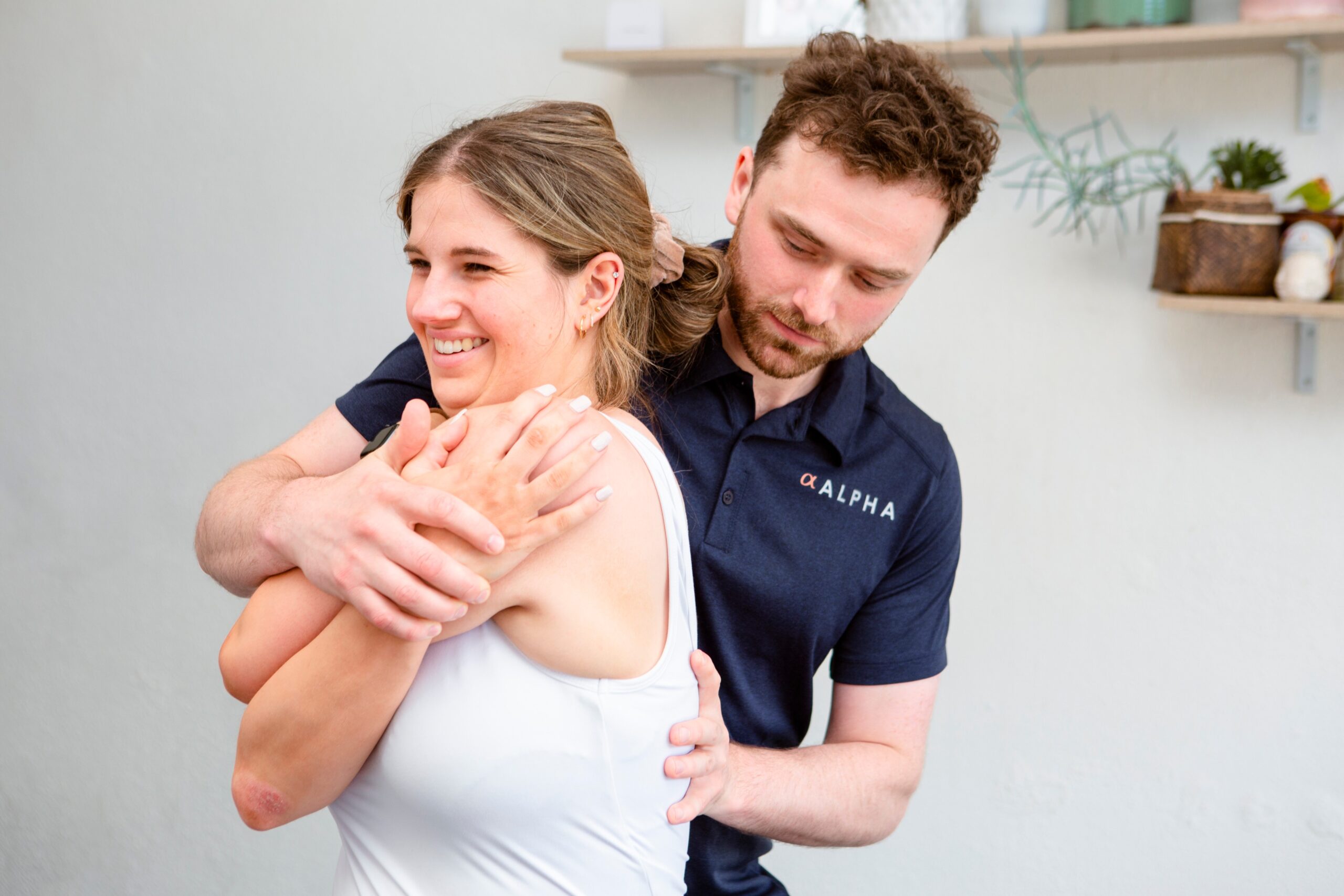
Alpha Sports Medicine practitioner guiding a patient through movement
Small changes in position may make nights more manageable
PLAN

How we treat shoulder pain

Strength is the treatment, not the afterthought

  1. 01

    Start with your goal

    Sleeping through, reaching the top shelf, pressing, swimming or throwing—what you want back shapes the whole plan.

  2. 02

    Assess beyond the shoulder

    We examine the shoulder, shoulder blade, neck and upper back, because each can change how the shoulder feels and works.

  3. 03

    Settle what is irritable

    Hands-on care may help ease pain and restore movement so that strengthening becomes possible.

  4. 04

    Build real strength

    A resistance band and three exercises is not a program—progressive, measured strengthening is central for most shoulder pain.

  5. 05

    Modify, do not stop

    We change the range, angle, grip or load so you can keep training while the shoulder builds capacity.

  6. 06

    Refer when it is warranted

    If imaging or a specialist opinion would change your management, we will say so and explain why.

A balanced conversation

When surgery is part of the picture

Surgery has a place for some shoulders. It is commonly discussed after a traumatic full-thickness rotator cuff tear in a younger person, for recurrent instability or dislocation, and for shoulders that have not responded to a proper course of rehabilitation.

Rehabilitation does not repair a torn tendon. What it can do is help build the strength and movement around it. Every surgical decision belongs to you and your surgeon, and we are glad to help you prepare for that conversation.

TEAM

Who you may see

Who you will see

MORE

Related support

Explore connected concerns

CLINICS

Shoulder pain treatment in Melbourne

See the team close to home

Ascot Vale

246A Union Rd

View clinic

Newport

109 Blackshaws Rd

View clinic

Bacchus Marsh

3 Graham St

View clinic

Hawthorn

1/432 Burwood Rd

View clinic
FAQ

Common questions

Shoulder pain FAQs

Do I need surgery for a rotator cuff tear?

Not necessarily. Many people with rotator cuff tears are managed with rehabilitation first. Surgery is more commonly considered after a traumatic tear in a younger person, or when a shoulder has not responded to a proper course of rehab. That decision belongs with you and your surgeon.

Why does my shoulder hurt more at night?

There is less to distract you, you hold one position for a long time and lying on the sore side compresses it. Adjusting your sleeping position and using pillows to support the arm may help. Severe night pain that is not shifting should be reviewed.

How long does shoulder pain take to settle?

Rotator cuff-related shoulder pain typically responds over months rather than weeks, and frozen shoulder can take longer again. The timeframe depends on the cause, how long it has been there, your starting strength and what you want to get back to.

Should I stop going to the gym?

Usually not. Many people can keep training by changing the range, angle, grip or load of the movements that aggravate the shoulder, then progressing as it builds capacity. A dislocation or sudden loss of strength after an injury needs assessment first.

Do I need a scan?

Many shoulder presentations can be assessed clinically first. Imaging may be useful after significant trauma, when a serious injury is suspected, when the shoulder is not progressing as expected, or when the result would change management. If you already have a scan, bring the report along.

Is it my neck?

It can be. Pain that changes with neck movement, spreads below the elbow or comes with pins and needles may be coming from the neck. Checking the neck is part of every shoulder assessment we do.

Do I need a referral?

No. You can book directly.

How many sessions will I need?

It depends on the cause, how long it has been there and your goal. After your first assessment we will explain what we think is happening and outline a plan, including how often we suggest seeing you and how much of the work you can do on your own.

MOVE

Your next step

What has your shoulder stopped you doing?

Tell us what you want to get back to. We will assess the shoulder, explain what we find and build the next step with you.